

Sometimes it’s the small changes that make a big difference when playing the gong. That’s exactly what our new ollihess overtone grip—which Olli affectionately calls the OTG—is all about. With it, you can individually adjust the length of your gong mallet and thus draw out specific, subtle overtones from your gong.
By the way, the idea isn't entirely new: We actually had an overtone pick in our lineup 16 years ago. Now it's back—completely redesigned and ready for new sound experiments!
What is the ollihess overtone chord?
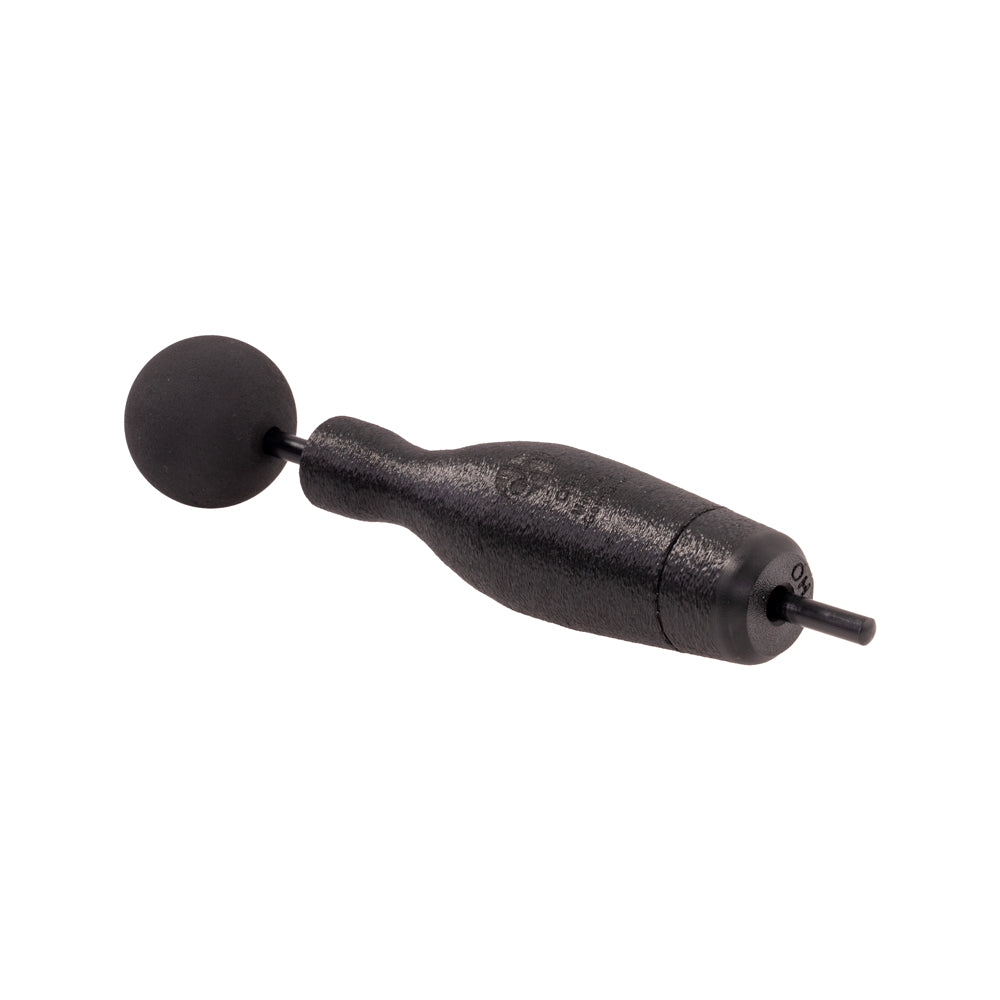
Our Obertongriff is an adjustable handle for gong mallets that allows you to change the effective length of the mallet shaft. Depending on how far you insert the friction mallet into the handle, the response and feel of the mallet will change. This allows you to fine-tune your friction mallet to better suit your gong and playing technique.
The OTG feels especially comfortable in your hand. Its compact, rounded shape fits snugly in the palm of your hand, giving you a comfortable gaming experience.
There's a small but important detail in the design: An O-ring in the handle ensures that the friction mallet fits particularly securely and prevents annoying background noise while playing.
The overtone handle fits all ollihess friction mallet with a handle diameter of 6 mm, including our Lava Edition, Smooth Lava Edition, and Crazy Egg.

Three Advantages of the Overtone Chord
1. Deliberately bring out subtle overtones
Do you love the delicate, high overtones that can be produced when playing with gong mallets? The overtone grip gives you an additional way to shape these sounds more intentionally.
Thanks to the adjustable slide length, you can experiment to find the setting at which your gong responds best and which overtones stand out.
What makes it special: With the right setting, you hardly need to apply any pressure when rubbing. This makes it particularly easy to produce subtle overtones with precision.
2. Customize your gong mallet
Every gong responds differently—and your playing technique also affects the sound. That’s why there isn’t one single setting that works every time.
Using the overtone knob, you can adjust the length of your slider and gradually fine-tune the setting that works best for your gong and the sound you want to achieve.
You can even equip multiple gong scrapers with an OTG each and configure them differently. This allows you to set up different pitches and switch between them directly while playing, without having to search for the right setting each time.

3. More sound possibilities with your existing scrapers
You don't necessarily have to buy a new gong mallet to discover new sound possibilities. The overtone grip complements your existing ollihess friction mallet with a 6 mm shaft and opens up additional possibilities for your playing.
This is especially exciting if you already own different friction mallet and want to find out how their sound can be influenced by changing their length.
Thanks to its comfortable grip and secure hold, you can focus entirely on your playing technique and the sounds you produce.
Practical Tip: Three friction mallet, three pitches
If you equip two or three gong strikers with an overtone grip each, you can tune them to different pitches and then switch directly between them.
Try it out with three graters, for example:
- Adjust the first " friction mallet " so that you produce a relatively low overtone.
- Tune the second one to a slightly higher overtone.
- For the third one, experiment with another setting until you find a suitable third sound.
Once you've found your settings, you can alternate between the three friction mallet while playing the gong. This creates different pitches without requiring you to spend a long time readjusting in between.
This is especially useful for sound baths or sound meditations: You can switch between different overtones as needed to create varied sound sequences.
Of course, this also works with just one friction mallet. Adjust the length gradually and listen closely to how the overtones and the feel of the instrument change.
Conclusion: A small step toward new sound experiments
With the ollihess overtone grip, you can get even more out of your existing gong strikers. The adjustable length allows you to change the response and playing feel and to experiment specifically with subtle overtones.
Particularly convenient features include the comfortable grip, the virtually pressure-free rubbing motion, and the ability to prepare multiple friction mallet for different pitches.
Curious? Then discover the ollihess overtone technique now and see for yourself what overtones your gong has to offer.