


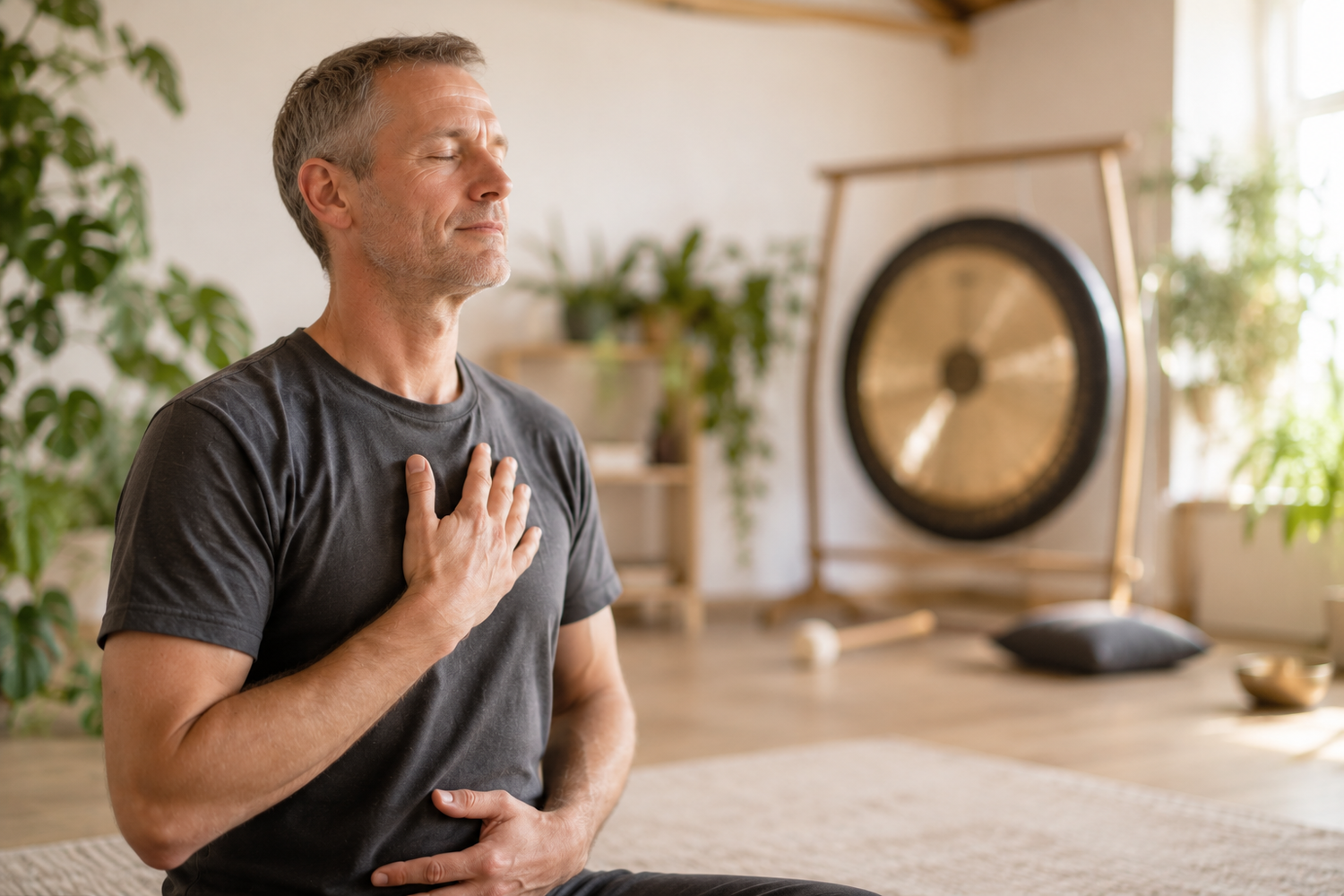
How the Sound of Gongs and singing bowls Affects singing bowls Breathing
Our breathing usually happens all on its own. It is the foundation of all life and the most important tool for meditation, yoga, and inner peace. In many spiritual traditions, the breath is considered the carrier of life energy (chi or prana), which connects all living beings.
Most of the time, we don’t pay attention to our breathing until we consciously focus on it. Or we don’t truly realize its importance until we find it difficult to breathe. Our breathing also changes in unfamiliar or stressful situations. Sometimes we unconsciously hold our breath, breathe more shallowly, or tense up our bodies.
The sounds of a gong or a singing bowl can influence our breathing. Especially in the fields of sound healing and breathwork, this connection is being used more and more frequently to deepen awareness and create a calm soundscape. Many people report that the vibrations make their breathing calmer, deeper, or slower. But what could be the reason for this? Are there already scientific explanations for it—or is it purely a matter of subjective experience?
Breathing and the nervous system are closely linked
There are many functions of our body that we cannot directly or immediately influence. Our heartbeat, blood pressure, and digestion all occur automatically. With our breathing, however, both are possible: it occurs automatically and can also be consciously controlled. It is precisely this connection that makes it so fascinating. If we consciously change our breathing, this can influence processes in the autonomic nervous system and, for example, affect our heart rate, perception of stress, or relaxation.
Calm, slow breathing is often associated with increased activity of the parasympathetic nervous system —that is, the part of the nervous system more closely linked to rest and recovery. Conversely, stress is often accompanied by faster, shallower breathing. This is closely related to the activation of the sympathetic nervous system, which prepares the body for increased alertness and readiness to perform.

How singing bowls of gongs and singing bowls can indirectly support breathing
The sound of a gong or a singing bowl our attention more strongly to our immediate hearing and perception. Our thoughts become calmer, and we focus more and more on our sensory stimuli. As we concentrate our attention, our breathing usually changes as well, without us consciously intervening. Instead of consciously controlling our breath, we observe it more and more. This creates a space in which the body can let go more easily and the breath finds its own rhythm.
Studies on mindfulness and meditation practices suggest that being consciously aware through all our senses can reduce rumination and inner tension. And this is often accompanied by calmer, more even breathing.
The rhythm of gong sounds can affect breathing
A gong meditation or gong bath is generally not strictly rhythmic—yet the vibrations do have temporal structures.
Scientific research has shown that our brain responds to recurring auditory stimuli. In this process, biological rhythms can, to a certain extent, synchronize with external rhythms. This phenomenon is known as entrainment. During entrainment, two or more independent, rhythmic systems synchronize with one another.
Studies have shown that when people listen to music, their breathing rate or heart rate can change depending on the tempo and dynamics.

In practice, many people find that their attention focuses singing bowl on their breath when listening to the calm sounds of a gong or a singing bowl . Scientifically, however, this connection has been studied only to a limited extent so far.
Sound Healing and Breathwork – Consciously Connecting Breath and Sound
Just as with our breathing, we can also perceive sounds. When we listen mindfully, we first allow the sounds to come to us and sense where we want to receive them. Then we follow them as they fade away, letting them go in the process. Something very similar happens when we follow our inhalations and exhalations and consciously observe how the breath comes and goes.
It can therefore be helpful to consciously connect sound meditations with your breath. Over time, a resonance often develops between your breath, your body, and the sound—your attention becomes focused, and the experience of sound becomes more intense.
Scientific Studies on Breathing by the Professional Association for Sound
In a study, the professional association Klang examined different breathing durations. Both subjective well-being and physiological parameters such as heart and brain activity were measured. The results showed that slower breathing—at about 10 seconds per breath (corresponding to approximately 6 breaths per minute)—can be particularly beneficial. Participants reported feeling more relaxed. At the same time, changes in heart and brain activity were measured that indicate an enhanced relaxation response. A slightly longer exhalation compared to the inhalation proved to be particularly effective.
Everyone reacts differently to sound
Given all the experiences and insights we’ve gained here, it’s always important to us to emphasize that everyone experiences sound differently. While some people notice calmer breathing after just a few minutes, for others it remains virtually unchanged. How the experience actually feels can depend, among other things, on how you’re feeling that day, your stress level, or your personal expectations.
What does this mean for your sound practice?
If you lead gong meditation sessions or sound baths yourself, you don’t need to guide your participants’ breathing. Often, it’s enough simply to create an authentic soundscape with gentle sounds and give people time to find their own rhythm.
Mindful sounds, deliberate pauses, and a gentle approach to dynamics can help each person develop their own unique connection to sound and breath.
Olli Hess
If you already have experience with various breathing techniques and are well-versed in the prerequisites and risks, you can incorporate them into your sound meditations, sound baths, or even sound therapy. There are numerous ways to combine sound and breathing. Internationally, this combination is often referred to as “sound healing” and “breathwork.” In these practices, breathing exercises are combined with sounds singing bowls such as those from gongs or singing bowls The most appropriate approach always depends on the individual and the chosen setting. Find your own path, or let our exercise inspire you.
Practical Exercise: Gong-Guided Connected Deep Breathing
A particularly effective form of sound-assisted breathing is gong-guided deep breathing. You can practice this on your own or lead a group in this exercise.
Here's how it works:
- Find a comfortable sitting or lying position.
- Your eyes can easily remain open or be closed.
- Now breathe in through your nose, strike the gong at the same time, and count from 1 to 10. Imagine the sounds flowing toward you.
- Breathe deeply into your belly.
- When you reach 10, exhale through your slightly open mouth and count from 1 to 10 again.
- As you do this, let your breath flow deeply out of your belly and back out into the air.
- At the end of your exhalation, start over: Begin inhaling and strike the gong at the same time. Count from 1 to 10.
- When you reach 10, begin exhaling and focus on the sound of the gong as it fades away. Count to 10 again as you do so.
- Make sure that your inhalation and exhalation are directly linked.
- Continue doing this for about 2–3 minutes.
The breathing itself is performed as connected breathing, as is also practiced in Holotropic Breathing according to Stanislav Grof. Deep breaths are taken without a pause between inhalation and exhalation.
Note: Connected breathing can trigger intense physical and emotional reactions. Only perform this exercise if you are feeling well, and stop immediately if you experience dizziness or feel unwell. If you have certain medical conditions* or are pregnant, you should only use this breathing technique after consulting a doctor or under the guidance of a qualified professional.
The Connection Between Sounds and Breathing—Our Conclusion
As you can see, sound and breathing are closely connected. Even though you can’t directly control singing bowl breath with a gong or a singing bowl , musical instruments can create a space in which your breathing naturally calms down and deepens. You can experience and explore this both in your own sound practice and when leading sound meditations or sound baths. Take the time to experiment with it. Everyone experiences sound differently—and that is precisely what makes this experience so unique.
Studies
Russo et al. (2017) – Slow Breathing and the Nervous System
The physiological effects of slow breathing in healthy humans
Bernardi et al. (2009) – Music Influences Breathing and Heart Rate
Dynamic Interactions Between Musical, Cardiovascular, and Cerebral Rhythms in Humans
Hinterberger et al. / Fachverband Klang (2019)
Fachverband Klang – Science and Research
*Schizophrenia, untreated bipolar disorder or psychosis, untreated post-traumatic stress disorder (PTSD), epilepsy or seizure disorders, heart disease or cardiac arrhythmias, COPD or existing lung diseases, a sensitive and/or early pregnancy, high blood pressure, very low blood pressure with fainting spells, severe asthma, glaucoma and/or retinal detachment, as well as severe osteoporosis or a recent major surgery