

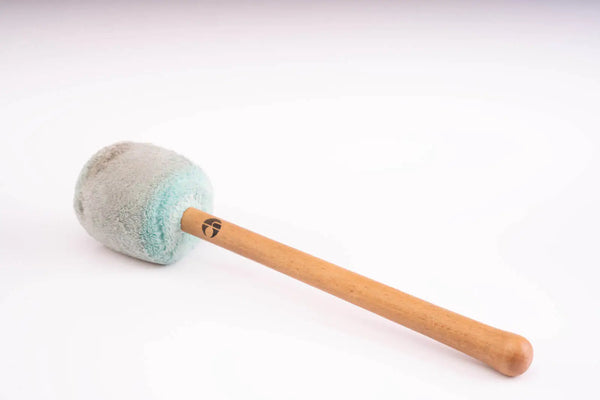
From time to time we receive inquiries that a gong mallet or gong driver can no longer produce the full sound spectrum on an instrument. Perhaps you too are sometimes frustrated to find that after a while you can no longer produce the desired sounds on your gong.
One of the most common problems is that the rubber ball or even the fleece of the mallet or reamer has hardened - and this of course means that you can no longer produce the desired sounds on your sound instrument.
The altered sound is usually not due to the quality of the mallet or friction mallet, but is almost always related to the care and use of the gong and mallet. Also, 'snail trails,' meaning streaks or crumbs on your gong, are due to residues from cleaning agents or dirt that were previously picked up by the gong mallet or friction mallet.
To prevent this from happening in the first place, we have summarized the most common causes, best care tips and simple application recommendations for you in this article.
Common reasons why your mallet or friction mallet no longer produces the desired sounds
There are various reasons why you might no longer be able to produce the desired sounds with your tools – meaning your mallet or friction mallet. However, they all share one common outcome: the hardening of the caoutchouc ball or the wellness fleece, which significantly impacts the sound.
These are the most common causes of altered sound
- Residues of cleaning or polishing agents have remained on the instrument and have collected on the rubber ball or on the fleece of the mallet.
- Dust or dirt has accumulated on the gong and was picked up by your mallet or friction mallet during playing.
- Due to unprotected storage of the mallets or friction mallets, dust and dirt have accumulated on the mallet heads, or UV radiation has damaged the material.
- Deposits such as dust and dirt in the fleece of the gong mallet
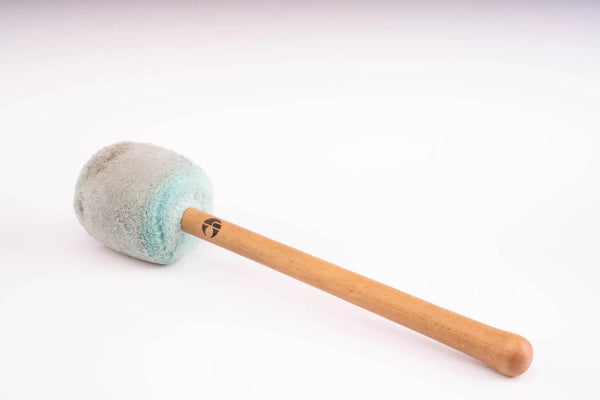
Deposits on the rubber ball of the gong mallet
Deposits caused by dust or residues from polishing & cleaning agents
The most common problem is that a gong mallet or friction mallet attracts dirt, such as dust or residues from cleaning agents that are still on the gong. Specifically, residues from polishes or soap cause the mallet surface to harden – and this naturally has an immediate effect on the sound you want to produce with this mallet or friction mallet on your gong. Severely hardened caoutchouc balls look almost as if they have been dipped in silicone.
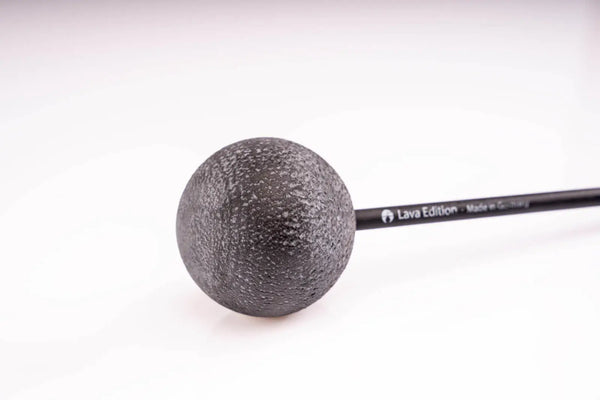 Deposits on the rubber ball of the gong mallet
In very rare cases, a speck of dust from grinding the rubber ball may remain on the surface of the mallet head and cause an unwanted noise when playing your gong.
Unfortunately, a hardened layer on a gong mallet or friction mallet often only becomes noticeable after one or two years. By then, it's usually too late to reverse the process. To prevent this from happening in the first place, we've put together some simple tips for you.
How to care for your gong mallets and mallets properly
We keep our promise: All ollihess gong mallets or gong drivers have a long life if you follow a few simple tips for care and use.
The most important thing is to look after your gong properly. This is because dirt or dust that has accumulated on a gong is always picked up by the mallet when it is played. So let's start with the most important tips for gong care.
Clean your gong properly
Clean a nickel silver gong with a dry microfiber cloth before every play. You can warm the cloth slightly beforehand - this makes polishing even easier.
You can remove dirt from a TamTam or Feng Gong with a damp, soft cotton cloth. However, you should then rub the gong dry.
Choosing the right cleaning agent for your gong
Only use professional cleaning agents to clean your gong. We advise against using agents that are not explicitly suitable for cleaning sound instruments.
We recommend using a special cleaning stone every two to three months for coarse dirt on a TamTam or Feng Gong. However, make sure that you rub the gong dry carefully after the cleaning process so that no powder residue remains.
In the past, ammonia-based cleaning agents were often used for nickel silver gongs - but these are no longer available. The use of furniture polish can also have a lasting effect on the sound of your instrument, as it hermetically seals the surface of a gong.
Correct storage
Dust and UV radiation can damage your tools. Therefore, you should always store your ollihess mallets and friction mallets in the provided cotton pouch after use.

You can protect our gong mallets from dust and UV radiation in the paper bag in which we pack them. Excessive humidity can affect the beech wood we use to make the handles of our mallets. Therefore, make sure they are stored as dry as possible. Of course, other packaging such as small boxes or bags are also suitable for safe storage.
Stay tuned: Soon, ollihess friction mallets will also receive new packaging that is perfect for storage.
But not only mallets and friction mallets need good protection: you can also store your gong in a soft cover or a gong bag. If it stands unprotected in the room, don't forget to clean it regularly.
How to prevent your friction mallets from hardening
If the hardened layer on the rubber ball is not yet that thick, you can try to loosen it with hot water. You can use this gentle cleaning method regularly.
This is how you proceed:
- Boil about one liter of water.
- Hold the beater head over a sink and let the water run carefully over the ball.
- Observe the caoutchouc: The hot water gives it a kind of shock and it "unfolds" once again.
- Then place the mallet or friction mallet on the windowsill and let it dry slowly in the sun or on a heater.
If this method isn't successful, you can also gently rub the caoutchouc ball with 40 or 60 grit sandpaper. You should definitely avoid soaking them in cleaning or care products that are not specifically designed for mallets or friction mallets.
Please note, however: While we promise a particularly long lifespan for all our products, even natural caoutchouc cannot last forever. This applies not only to bicycle or car tires but unfortunately also to gong mallets and friction mallets. Friction and dirt affect the material over the years, thereby influencing its surface.
How to care for the wellness fleece of a gong mallet correctly
The particularly soft wellness fleece of ollihess mallets and friction mallets should only be cleaned when absolutely necessary. This is because water affects the insulating layer of the material, making it harder. Since the mallet head is also entirely ecologically constructed under the fleece, water can negatively impact the insulation here as well. Therefore, you should proceed with particular care during cleaning.
This is how you proceed:
- Moisten a sponge or cloth and rub it over the fleece in a circular motion.
- Then place the mallet on the windowsill and leave it to dry in the sun or on the radiator.
How to care for felt balls properly
The felt ball of a gong mallet - such as the ball of the Profi Gong Mallet J.O.-70 - has a very specific degree of hardness (e.g. 100 or 200 Shore). If the ball is processed too wet or with too much pressure, the degree of hardness and also the shape can change. Naturally, this in turn affects the sound. Nevertheless, you can also clean felt heads very gently.
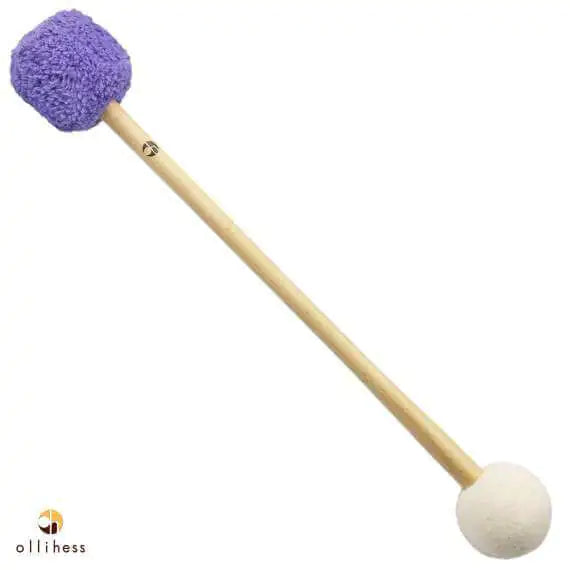
This is how you proceed:
- Moisten a sponge or cloth with water and rub carefully over the soiled area on the felt ball.
- As the felt ball is particularly sensitive when wet, hang the mallet up to dry afterwards.
Tip: The ball in the core of our super light professional gong mallet lite 100 or lite 200 is also made of felt. So if your mallet gets wet, make sure that you don't apply pressure to it and hang it up to dry.
How to properly care for the wooden handle of mallets and friction mallets
The wooden handle does not usually require much care. But if necessary, you can wax it again after a while. We recommend an organic wax for this, as we also use it in production.
If you follow these simple tips, you are sure to enjoy our products for a long time. If you are unsure or have further questions about care that are not answered here, you can contact us at any time.